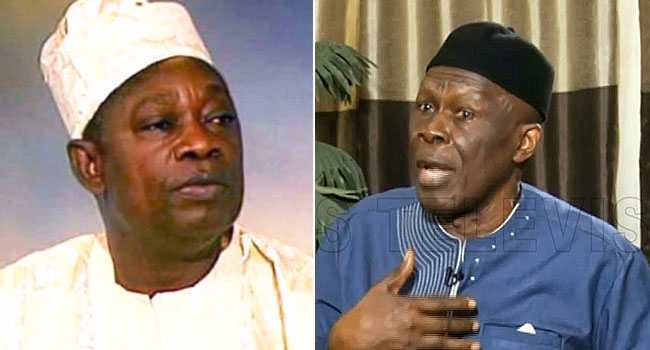
Senator Adams Oshiomhole has criticized the former Chairman of the defunct National Electoral Commission (NEC), Humphrey Nwosu, for his handling of the June 12, 1993, presidential election.
Widely regarded as one of Nigeria’s freest and fairest elections, the poll was believed to have been won by the late businessman and industrialist Moshood Abiola of the Social Democratic Party (SDP).
Grassroots Parrot reports that 32 years later, Oshiomhole, who represents Edo North in the National Assembly, faulted Nwosu for failing to declare the election results.
The former Edo State Governor spoke on Channels Television on the failed motion by the southern lawmakers at the National Assembly to immortalize Nwosu, arguing that Nwosu should have announced the winner, regardless of potential consequences.
“If Nwosu had declared him, heaven would not fall,” Oshiomhole said. “At worst, they would have detained or even killed him, but he would have followed the law enacted by the military.”
READ ALSO: I Regret Annulment Of June 12 Election— Babangida
“We told him that after conducting the election, the next logical step was to declare the winner. Abiola died pursuing his mandate.
He had to proclaim himself the winner, which Nwosu should have done. “If Abiola, a businessman without a political science background, had the courage to claim victory, then someone with Nwosu’s expertise should have done even better.” he said.
At the time, Nigeria’s Military President, General Ibrahim Babangida, annulled the June 12, 1993, presidential election, backtracking on his promise to return power to a civilian government. Babangida justified his decision in a decree, claiming, “These steps were taken to save our judiciary from being ridiculed and politicized locally and internationally.”
The annulment sparked widespread condemnation, both within Nigeria and globally. Western diplomats and opposition leaders dismissed Babangida’s justification as an excuse to prolong military rule.
Babangida also suspended the National Electoral Commission—then led by the late Professor Humphrey Nwosu—the body responsible for overseeing Nigeria’s democratic transition.
The election, conducted across Nigeria’s 30 states, covered regions more populous and economically significant than many African nations. Although voter turnout was relatively low, foreign observers reported no significant incidents of violence or electoral fraud, affirming that the process was largely free and fair.
More than three decades later, Babangida finally acknowledged that Abiola won the June 12 election. In his newly released autobiography, A Journey in Service, presented in Abuja on February 20, the retired general admitted for the first time that the election results confirmed Abiola’s victory.
READ ALSO: Abacha’s Son Defends Late Father Following IBB’s Revelations
The annulment of the election marked a turning point in Nigeria’s democratic history, triggering a political crisis and hastening Babangida’s exit from power.
“As the leader of the military administration, I accept full responsibility for all decisions taken under my watch,” Babangida stated during the book presentation. “Mistakes, oversights, and missteps happened in quick succession. But as I mention in my book, in all matters, we acted in the supreme national interest to ensure Nigeria’s survival.”
He added, “Our nation’s march to democracy was interrupted, a fact that I deeply regret. But Nigeria survived, and democracy remains alive—a testament to our resilience and commitment to progress. This book is part of my personal story within the broader national history.”