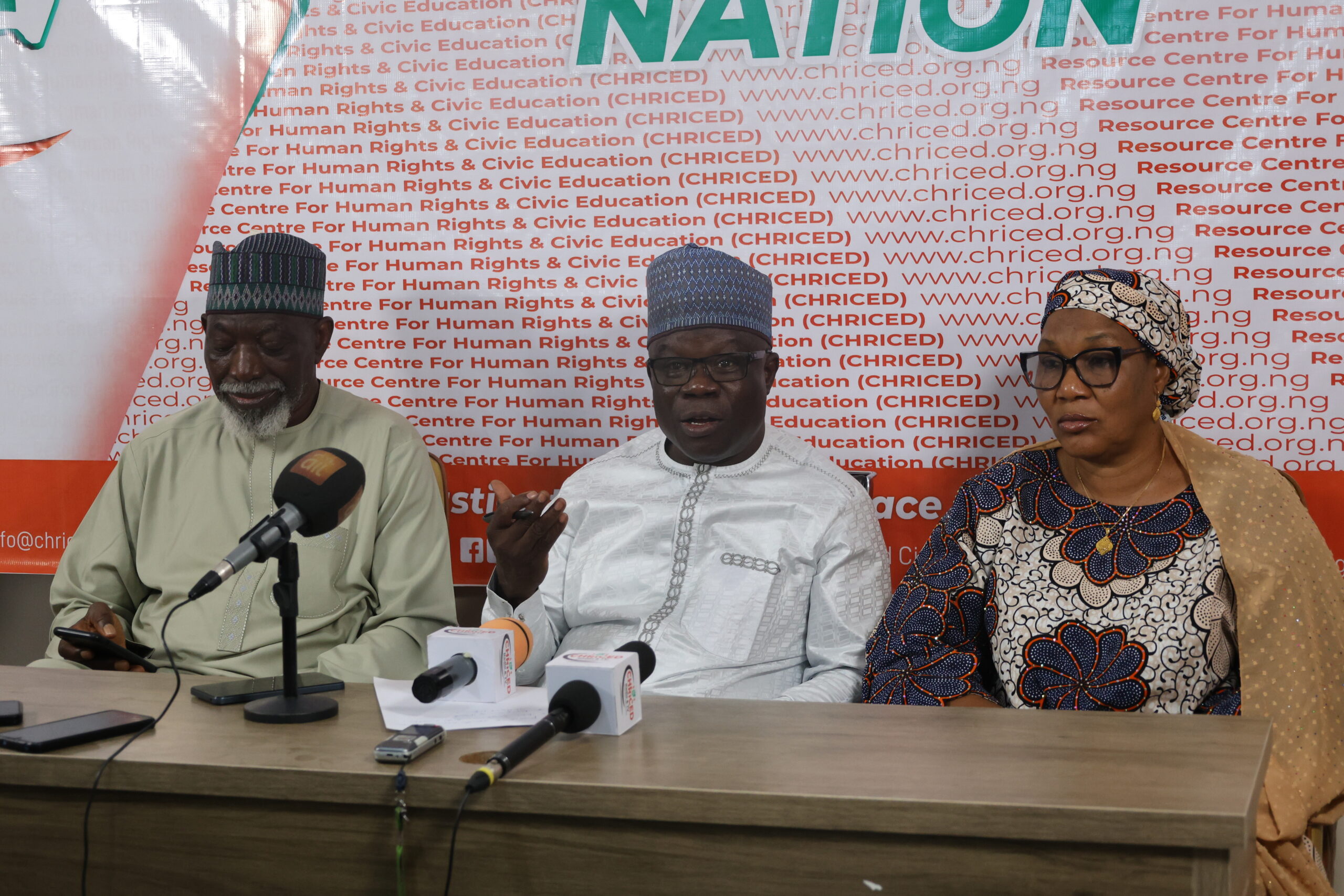
The Resource Centre for Human Rights and Civic Education has warned that Nigeria’s social, economic and democratic foundations deteriorated further in 2025, insisting that the country is now at a crossroads where continued silence could prove fatal to its future.
Speaking at a new year media briefing in Abuja on Saturday, the Executive Director of CHRICED, Comrade Ibrahim M. Zikirullahi, said the past year subjected Nigerians to “trials, truths and turning points,” marked by worsening hardship, weak governance and shrinking democratic space.
Zikirullahi said Nigerians entered 2025 with hope that lessons from previous years would inspire empathy and accountability in leadership, but were instead confronted with deepening poverty, widening inequality and a political class increasingly detached from the realities of ordinary citizens.
“Shrinking incomes and a cost-of-living crisis that pushed millions to the brink,” he said. “Inflation climbed, the naira weakened further, jobs disappeared and hunger tightened its grip on households already stretched beyond endurance.”
He noted that while official data sometimes suggested a moderation in inflation, the daily experiences of Nigerians told a different story, with food, transportation and healthcare costs remaining unaffordable for many.
According to him, even the reported drop in prices of some grains offered little relief, as poor households lacked the income to take advantage of the reductions.
“The government celebrates partial price drops, but farmers are counting losses because there is no holistic approach to fertiliser costs, transportation and labour,” Zikirullahi said, warning that many farmers could abandon cultivation next season, worsening food insecurity.
The CHRICED boss said the weakened naira continued to drive up the cost of imported and locally produced goods, forcing small businesses to shut down, parents to withdraw children from school and families to reduce meals.
He added that government policies, including higher taxes and bank charges, compounded the suffering of citizens.
READ ALSO: CHRICED Demands Halt to Allegedly Altered Tax Laws, Prosecution of Culprits
“In 2025, government-induced suffering did not just bring its own stool; it made itself a home in the lives of millions,” he said, cautioning that without urgent corrective action, 2026 could become another year of normalized hardship.
Zikirullahi also criticised what he described as “extravagance in the midst of scarcity,” accusing political leaders of indulging in luxury while urging citizens to make sacrifices.
He lamented the continued neglect of the Oronsaye Report, saying its failure to be implemented reflected a lack of political will to reduce the cost of governance.
“A government that asks the poor to endure hardship while expanding its own privileges has lost its moral compass,” he said.
On democracy, Zikirullahi said off-cycle elections in 2025 exposed the fragility of Nigeria’s electoral system, citing allegations of voter suppression, violence and manipulation.
He said many local government elections were reduced to “coronations” for ruling parties, undermining public trust.
He expressed concern over what he described as an accelerated drift toward a one-party state, pointing to mass defections of opposition lawmakers and governors to the ruling party.
According to him, the trend has weakened accountability, endangered judicial independence and fuelled public disillusionment.
“This is not speculative; it is observable and dangerous,” he said, warning that Nigeria risks becoming a democracy only in form, not substance.
On insecurity, Zikirullahi said Nigerians remained under siege despite huge budgetary allocations to defence, with kidnappings, banditry and violent crime persisting across the country.
He said communities had been displaced, farms abandoned and businesses shut down, adding that security must go beyond slogans to tangible action.
He further decried what he described as a shrinking civic space, alleging that peaceful protesters, journalists and activists faced harassment and intimidation in 2025.
“A democracy without dissent is a democracy in name only,” he said, insisting that civic freedoms were non-negotiable and central to accountability.
Zikirullahi said Nigeria now faced defining choices in 2026, urging leaders to show courage by reducing the cost of governance, reforming key institutions, strengthening the electoral process and protecting civic rights.
READ ALSO: One-Party Drift Threatens Nigeria’s Democracy, CHRICED Warns
He also called on citizens to transform resilience into action by holding leaders accountable and refusing to surrender their democratic power.
“The message of 2025 is clear,” he said. “The people are suffering, the system is failing, and silence is no longer an option.”
He, however, maintained that hope was not lost, saying Nigerians had survived the worst and could still build a just and dignified society if collective resolve replaced apathy.