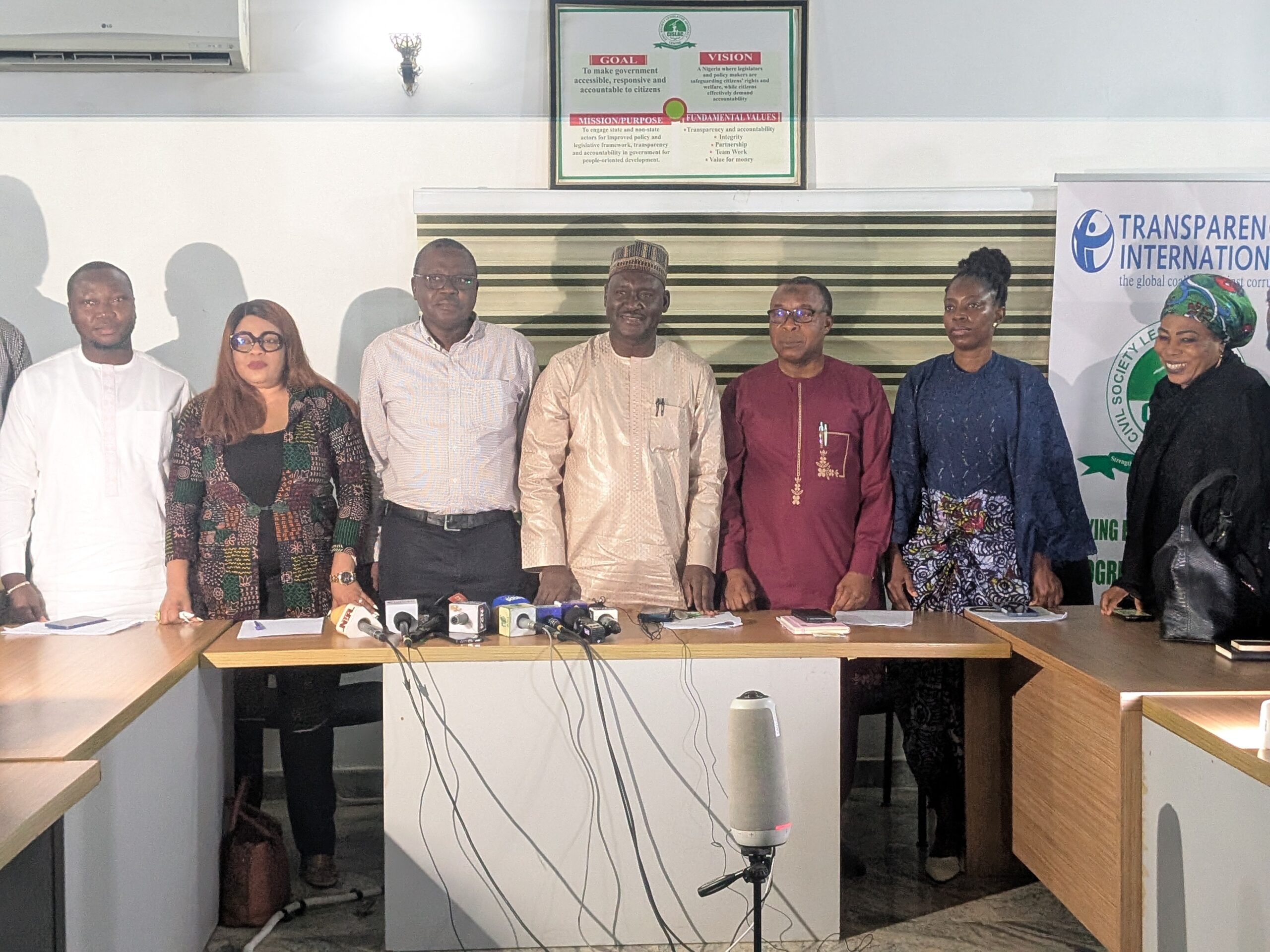
A coalition of about 90 Civil Society Organisations (CSOs) has kicked against the Foreign Aids (Regulation, Transparency and Disclosure) Bill, 2026, warning that the proposed legislation could give government sweeping powers to regulate civil society organisations and undermine civic freedoms in Nigeria.
The coalition, comprising Nigerian, African and international human rights and civil society organisations, made its position known on Monday at a joint press conference on protecting civic space, constitutional freedoms and democratic governance.
The groups expressed particular concern over the Foreign Aids Bill, 2026 (SB.1034), as well as proposed legislation seeking to compel social media platforms to establish physical offices in Nigeria or risk being prohibited from operating in the country.
Speaking at the briefing, the Executive Director of the Civil Society Legislative Advocacy Centre (CISLAC), Ibrahim Musa Rafsanjani, condemned the Foreign Aids Bill, describing it as a dangerous expansion of executive control over civil society.
Rafsanjani warned that the proposed legislation could undermine independent advocacy and legitimate democratic participation, stressing that “independent advocacy, investigative journalism and public scrutiny are not threats to democracy; they are essential safeguards of constitutional governance and accountability.”
READ ALSO: CHRICED Raises Alarm Over Tinubu’s Fiscal Recklessness, Democratic Backsliding
He said the proposed measures were particularly troubling as Nigeria approaches the 2027 general elections, when citizens, journalists, civil society organisations and political actors should be able to participate freely in the democratic process.
Also speaking, Dauda Garba, Director of the Centre for Democracy and Development (CDD), drew attention to provisions of the bill which he said could give the proposed Foreign Aid Regulatory Commission extensive regulatory powers over organisations receiving foreign assistance.
According to him, Sections 3 to 5 empower the commission to register recipients, demand information, conduct inspections and audits, impose sanctions and enforce compliance with undefined “national policies and priorities.”
He further cited Sections 6 to 8, which require foreign-aid recipients to register with the commission within 30 days and criminalise non-registration, while Sections 9 to 11 impose annual audit requirements and seek to compel foreign-funded projects to align with government-defined national development priorities.
Garba said the provisions could create “significant risks of executive interference” in legitimate human rights, governance, anti-corruption, public interest litigation and accountability activities.
On her part, Olubunmi Aweda, Country Manager of Global Rights, argued that the proposed legislation conflicts with constitutional and international human rights protections.
Aweda cited Sections 39 and 40 of the 1999 Constitution, as amended, which protect freedom of expression, peaceful assembly and association, as well as Article 9 of the African Charter on Human and Peoples’ Rights, which protects freedom of expression.
Aweda also referenced Articles 10, 11 and 13 of the African Charter, which deal with freedom of association, assembly and participation in public affairs, alongside Articles 19, 21, 22 and 25 of the International Covenant on Civil and Political Rights.
She said any restriction on these rights must satisfy the principles of legality, legitimate purpose, necessity and proportionality, arguing that the proposed bills fail to meet those standards.
Isa Sanusi, Country Director of Amnesty International Nigeria, read the coalition’s demands, calling on the National Assembly to immediately withdraw the Foreign Aids (Regulation, Transparency and Disclosure) Bill, 2026, the proposed social media office legislation and other bills that unjustifiably restrict civic space.
Sanusi said the coalition also demanded that future legislation affecting civil society organisations, digital rights, media freedom and civic participation must fully comply with the Nigerian Constitution, the African Charter and the International Covenant on Civil and Political Rights.
The coalition further demanded genuine, transparent and meaningful consultations with civil society organisations, journalists, human rights defenders, professional associations, digital rights groups, development partners and other affected stakeholders before reforms affecting civic freedoms are adopted.
The organisations urged the National Assembly to reaffirm Nigeria’s commitment to constitutionalism, accountability, transparency, the rule of law and respect for human rights.
They warned that the National Assembly faces a “defining constitutional choice” between expanding executive control and shrinking civic space, or upholding constitutional freedoms and democratic governance.
The coalition therefore urged lawmakers to reject the bills in their entirety and instead enact legislation that protects civic space, strengthens transparency and accountability, promotes meaningful public participation and reinforces Nigeria’s democratic values.