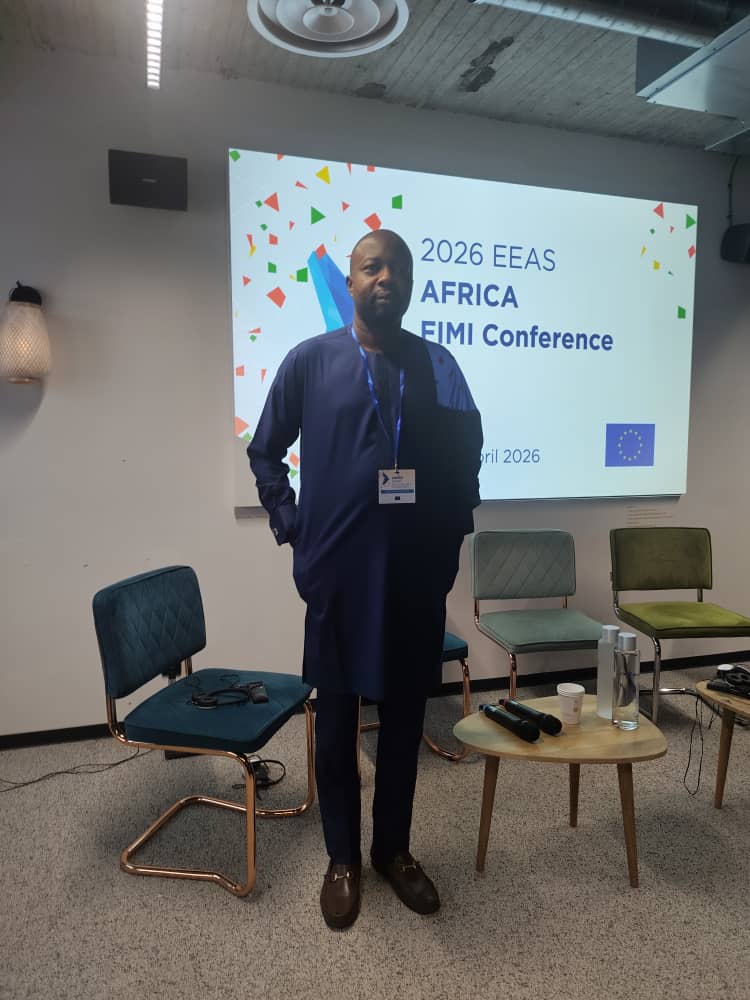
By Armsfree Ajanaku, Brussels
Experts from Africa and Europe have raised concerns over the growing threat posed by Foreign Information Manipulation and Interference (FIMI) to democracies across the world.
The concerns were highlighted during the 2026 Africa FIMI Conference organised by the European Union’s External Action Service (EEAS), held in Brussels on April 14 and 15.
The conference brought together policymakers, journalists, researchers, civil society groups, diplomats, and media experts to examine emerging FIMI trends in Africa and explore collective strategies for protecting democratic institutions and information integrity.
Participants described FIMI as a major danger to democracy, capable of weakening public trust, increasing political division, and undermining governance, security, and international partnerships.
There was broad agreement that African and European democracies must work together more closely to counter the growing influence of disinformation campaigns and foreign interference.
Discussions focused on the nature of FIMI in Africa, the actors behind such operations, and the tactics used to spread misleading narratives. According to the fourth EEAS FIMI report, 540 FIMI incidents were recorded between January and December 2025.
Russia was linked to 29 percent of the incidents, China to 6 percent, while most cases remained unattributed due to the secretive nature of such operations.
READ ALSO: Kidnappers Of Ekiti Worshipers Demand N1bn Ransom
Experts revealed that billions of dollars are spent annually on FIMI campaigns aimed at destabilising democratic societies.
Russia reportedly spends between $2 billion and $3 billion yearly on such operations, while China is believed to spend between $5 billion and $6 billion globally.
The conference also highlighted the growing role of Artificial Intelligence in spreading disinformation. EU monitoring data showed a 30 percent increase in AI-generated FIMI content in 2025, raising fears that future attacks may become more sophisticated and difficult to detect.
To address the challenge, the European Union introduced its proposed “Democracy Shield and Sword” strategy. The approach combines legal frameworks, sanctions, media literacy, resilience building, law enforcement, and international cooperation to counter disinformation networks and strengthen democratic institutions.
Participants stressed the importance of partnerships between governments, civil society organisations, independent media, and international bodies in combating FIMI.
However, some analysts warned that involving security agencies too heavily could risk over-securitising the response and blur the distinction between democratic and authoritarian tactics.
African participants also argued that Africa’s FIMI realities differ from Europe’s, especially because many African communities still rely heavily on offline communication channels due to the digital divide.
Historical issues such as colonialism and slavery were also identified as factors shaping African perceptions of global powers like China and Russia.
READ ALSO: Bandits Attack Wedding in Kaduna, Kill 13 And Abduct Several
The conference further examined regional FIMI trends across West, East, Southern, and Central Africa, while showcasing initiatives such as UNESCO-supported social media peace projects in South Africa.
Another major concern raised was the role of big technology companies in the spread of disinformation.
Participants expressed frustration that despite regulations like the EU Digital Services Act, many social media platforms are still failing to effectively tackle harmful content and coordinated manipulation campaigns.
The conference concluded with a strong call for improved collaboration, stronger information integrity systems, support for independent media, and more effective monitoring mechanisms ahead of major elections in Africa, including Nigeria’s 2027 general elections.